
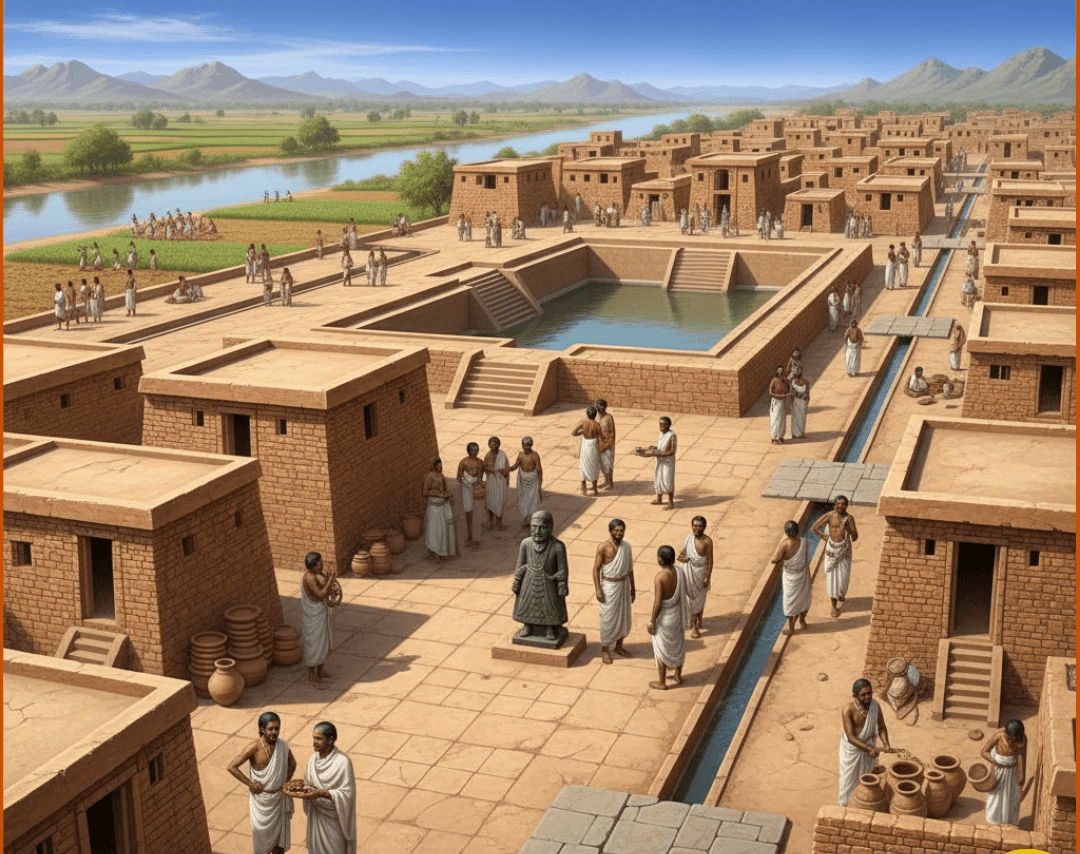
India's history spans roughly 5,000 years, which is more than most trip-planning guides have room to explain. Here's the condensed version that actually helps make sense of what you're seeing on the ground.
Key Takeaways
The Indus Valley Civilization (c. 2500 BCE) was one of the world's earliest urban societies, centered on cities like Mohenjo-daro and Harappa.
The Maurya Empire (322–185 BCE), under Emperor Ashoka, unified most of the subcontinent and spread Buddhism widely.
The Gupta Empire (c. 320–550 CE) is often called India's "Golden Age" for advances in science, mathematics, and the arts.
The Mughal Empire (1526–1857) left behind much of the architecture, including the Taj Mahal, that defines India's image today.
The Ancient and Classical Periods
The Indus Valley Civilization built planned cities with drainage systems remarkably advanced for their time, though much about its script and society remains undeciphered. Centuries later, the Maurya Empire under Ashoka unified most of the subcontinent, and the Gupta period that followed produced foundational advances still referenced today, including the concept of zero in mathematics.
The Mughal Era and Colonial Period
The Mughal Empire, established in 1526, blended Persian, Central Asian, and Indian influences into the architecture, cuisine, and art still visible across North India. British colonial rule followed, formalizing in 1858 after the East India Company era, and lasted until India's independence on August 15, 1947 — a date still marked by the country's biggest secular national holiday.
Good to Know Most major monuments you'll visit — the Taj Mahal, Red Fort, Fatehpur Sikri — date from the Mughal period, roughly 1526 to 1857. Independence in 1947 came alongside Partition, which split British India into India and Pakistan — a history that still shapes regional politics today. Museums in Delhi, Mumbai, and Kolkata offer deeper context than a single blog post can — worth an afternoon if the history genuinely interests you.
None of this history is static trivia — it's visible in the architecture, food, and regional identity you'll encounter on almost any Indian itinerary.


